
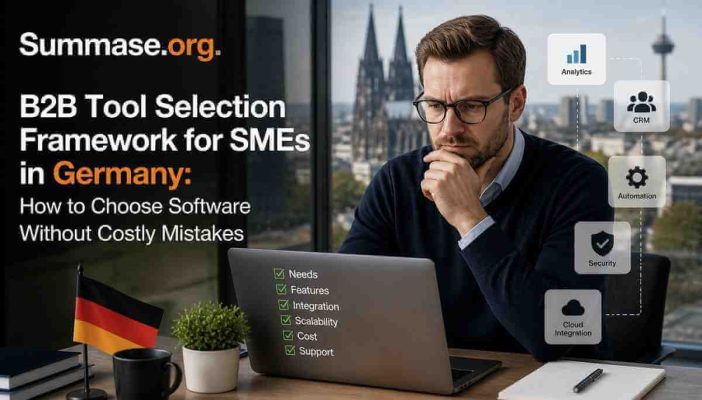
Somewhere between a polished demo and a signed subscription, something breaks.
Not immediately—but slowly.
The CRM that promised clarity becomes clutter.
The accounting tool doesn’t match your workflows.
The ERP feels like overkill.
Six months later, you’re paying for systems your team barely uses—and switching feels even more expensive than staying.
This isn’t a tool problem.
It’s a decision system problem.
And most SMEs never build one.
Why Most SMEs Make Expensive Software Decisions
The common mistake is not lack of research.
It’s how the decision is structured.
Typical flawed approach:
- Compare features
- Watch demos
- Read reviews
- Choose “what seems best”
This leads to:
- Feature overload
- Vendor bias
- Ignoring operational fit
- Underestimating switching cost
Result: Expensive lock-in and low adoption.
The Real Objective: Decision Defensibility
Instead of asking:
“What is the best tool?”
The better question is:
“Can I defend this decision 6 months from now?”
A strong decision must:
- Align with actual workflows
- Be explainable to stakeholders
- Survive operational stress
- Remain cost-efficient over time
The 5-Layer B2B Tool Selection Framework
This framework is designed for SMEs operating in structured environments like Germany.
Layer 1: Operational Fit
Does the tool match how your business actually works?
Ask:
- Does it reduce steps or add complexity?
- Does it match existing processes?
- Can your team adopt it without friction?
Red flag: Tools that require your business to adapt completely to them.
Layer 2: Cost Structure (Not Just Price)
Most SMEs underestimate total cost of ownership (TCO).
Consider:
- Subscription fees
- Setup time
- Training cost
- Integration cost
- Switching cost later
👉 For deeper analysis, see
“how to calculate tool switching cost”
Layer 3: Vendor Risk
A tool is not just software—it’s a dependency.
Evaluate:
- Vendor stability
- Data ownership terms
- Exit conditions
- Support quality
👉 Use a structured checklist:
“vendor due diligence checklist”
Layer 4: Compliance & Data Handling
Especially relevant in Germany.
Questions:
- Where is data stored?
- Who can access it?
- Is it GDPR-aware by design?
👉 Practical guide:
“gdpr data operations for SMEs”
Layer 5: Scalability & Future Fit
Will this tool still work when your business grows?
Check:
- User limits
- Feature expansion
- Integration ecosystem
- Pricing scalability
Original Value: The Decision Scorecard (Simple Version)
Use this structure to evaluate tools objectively:
| Criteria | Weight | Tool A | Tool B |
|---|---|---|---|
| Operational Fit | 30% | ||
| Cost Efficiency | 20% | ||
| Vendor Risk | 20% | ||
| Compliance Fit | 15% | ||
| Scalability | 15% |
Rule:
Never choose a tool based on total score alone.
Look for critical weaknesses.
Scenario: When a “Good Tool” Becomes a Bad Decision
A small logistics company selects a CRM with excellent features.
Problem:
- Requires manual data entry for orders
- No integration with existing systems
- Staff adoption drops
Outcome:
- Double work
- Low usage
- Hidden operational cost
Lesson:
Feature-rich ≠ operational fit.
Common Mistakes That Cost SMEs Thousands
1. Choosing Based on Features
More features often mean more complexity—not more value.
2. Ignoring Adoption Reality
If your team won’t use it, the tool fails—regardless of capability.
3. Underestimating Switching Cost
Migration is rarely simple.
4. Overvaluing Vendor Branding
Big names don’t guarantee fit.
A Practical 5-Step Decision Process
Step 1: Define Your Core Problem
Not “we need a CRM”
But: “we need to track customer interactions across 3 channels”
Step 2: Map Your Workflow
Document:
- Current process
- Bottlenecks
- Manual steps
Step 3: Shortlist Based on Constraints
Filter tools by:
- Budget range
- Integration requirements
- Team capability
Step 4: Score Using Framework
Use the 5-layer model.
Step 5: Run a Controlled Test
Never fully commit without:
- Trial phase
- Limited rollout
- Real workflow testing
Trust & Risk Note
This article provides operational guidance, not legal or financial advice.
For compliance-heavy decisions, consult a qualified professional—especially when handling sensitive data or contractual obligations.
FAQ
What is the biggest mistake SMEs make when choosing software?
Focusing on features instead of operational fit. A tool that doesn’t match workflows creates hidden costs and low adoption.
How many tools should SMEs evaluate?
Ideally 2–4 options. Too many choices reduce decision quality and increase bias.
Should SMEs always choose scalable tools?
Not always. Choose tools that fit current needs with reasonable growth capacity—not maximum complexity.
Final Thought
The real risk isn’t choosing the wrong tool.
It’s choosing without a system.
When decisions are structured, even imperfect tools can work.
But without structure, even the best tools fail.
Reference
- European Commission (GDPR basics)
- Official SME digitalization reports Germany
