
People rarely notice when their learning process begins to break down.
It usually starts with small compromises. Notes accumulate in different apps. Books are purchased faster than they are finished. Online courses remain half completed. Weeks pass with the uncomfortable feeling of being busy without becoming noticeably better at anything.
Many learners respond by searching for another productivity trick, another note-taking application, or another study challenge. Yet the problem often lies elsewhere.
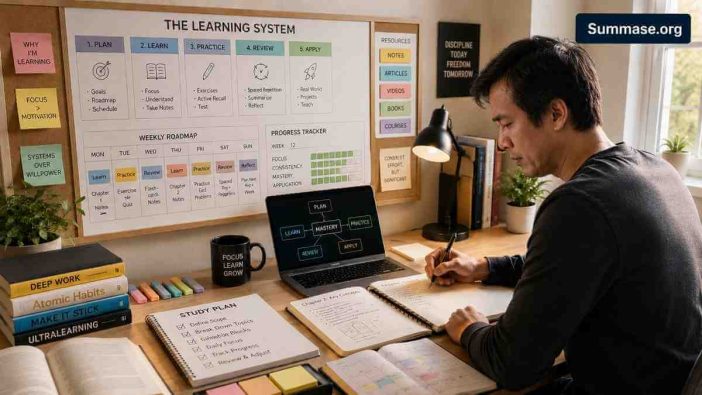
Learning is not merely an activity. It is a system.
Athletes rely on training systems. Businesses depend on operating systems. Pilots follow checklists because memory alone cannot be trusted under pressure.
Ironically, many people approach education as if remembering everything, maintaining discipline indefinitely, and staying motivated throughout the year were natural human abilities.
They are not.
A well-designed learning system reduces friction, preserves attention, and creates conditions where progress becomes easier to sustain.
This article explores how such a system can be designed intentionally rather than left to chance.
Why Most People Never Build a Learning System
People often assume they already have a study system.
They attend classes, highlight textbooks, watch educational videos, and occasionally review their notes. These activities may appear organized from the outside, but they do not necessarily form a system.
A learning system differs from isolated techniques because it answers four practical questions.
- What should I learn?
- When should I study?
- How will I retain information?
- How do I know whether progress is happening?
Without clear answers, learning tends to become reactive.
Someone preparing for an exam may study intensely for several days and then abandon the material entirely after the test.
A professional might enroll in five courses simultaneously, only to discover months later that none of the acquired knowledge has been applied.
A lifelong learner may spend years collecting books and resources while struggling to explain what new competencies have actually been gained.
The issue is rarely intelligence.
More often, the issue is the absence of structure.
Common Signs That Your Learning Process Needs a Redesign
You may benefit from building a learning system if several of these situations feel familiar.
- You constantly switch between learning methods.
- You forget information shortly after studying it.
- You struggle to decide what deserves attention.
- You consume educational content more often than you practice.
- You feel productive but cannot demonstrate measurable progress.
- You rely heavily on motivation to remain consistent.
None of these problems are unusual.
In fact, they are predictable outcomes when learning depends solely on willpower.
The Difference Between Studying and Designing a Learning Process
Studying is an action.
Designing a learning process is an architectural decision.
The distinction matters because actions can be repeated endlessly without producing meaningful results.
Imagine two individuals attempting to learn data analysis.
The first spends an hour each evening watching tutorials selected at random.
The second decides in advance:
- which skills need to be mastered;
- which projects will demonstrate competence;
- how frequently concepts should be reviewed;
- what criteria indicate readiness to move forward.
Both individuals invest time.
Only one invests time inside a structured environment.
This difference resembles the contrast between carrying bricks and constructing a house.
Activity alone does not guarantee progress.
A learning process requires intentional design.
A Shift From Consumption to Production
Many educational environments reward information intake.
Students read chapters.
Employees complete mandatory training.
Professionals subscribe to newsletters.
Yet expertise develops primarily through output.
Writing summaries.
Teaching concepts.
Solving problems.
Completing projects.
Answering questions without assistance.
Producing something tangible exposes weaknesses that passive consumption often hides.
One practical way to evaluate a learning process is to ask:
If I stopped reading today, what evidence would remain that I actually learned something?
For some people, the answer may be a portfolio.
For others, a published article, a completed spreadsheet, a coding project, or a presentation delivered confidently.
If no evidence exists, the learning process may require adjustment.
The Five Components of an Effective Learning System
Although learning goals vary widely, sustainable systems usually contain several common elements.
Removing one component often creates bottlenecks elsewhere.
1. Direction
Learning becomes inefficient when objectives remain vague.
Goals such as “improve English” or “learn programming” provide little guidance for daily decisions.
More effective objectives describe observable outcomes.
Examples include:
- Hold a thirty-minute conversation with a native speaker.
- Write an analytical article without external assistance.
- Build a personal finance spreadsheet.
- Pass a certification examination.
Direction prevents endless preparation.
2. Scheduling
Many people study only when they feel motivated.
Unfortunately, motivation fluctuates.
Scheduling transfers responsibility from emotion to routine.
Even three focused sessions per week often outperform irregular periods of intense effort.
Some learners prefer fixed blocks.
Others use flexible systems that assign weekly study hours rather than exact times.
The specific method matters less than its consistency.
3. Retention
Information naturally fades over time.
For this reason, successful learners rarely depend on rereading.
Instead, they revisit material strategically.
Methods such as active recall and spaced repetition have received considerable attention because they encourage retrieval rather than recognition.
Readers interested in long-term memory strategies may later explore our upcoming guide on Spaced Repetition Schedule Template (7–14–30 Day Model), which demonstrates a practical review framework suitable for students and working professionals alike.
4. Application
Knowledge remains fragile until it is used.
Someone studying public speaking benefits more from delivering presentations than from reading ten additional books about confidence.
Application transforms information into experience.
Small projects, reflective writing, and simulations often accelerate this transition.
5. Evaluation
Improvement becomes difficult when progress is invisible.
Evaluation does not necessarily require grades.
Simple indicators may be sufficient.
Examples include:
- Number of completed practice questions
- Time needed to solve a problem
- Accuracy rate
- Portfolio quality
- Ability to explain concepts clearly
Without feedback, learners frequently repeat ineffective habits for months or even years.
Editorial Note
People often search for the perfect learning technique.
In practice, the most effective system is rarely the most sophisticated one.
It is usually the one that remains usable during busy weeks, unexpected interruptions, and periods when enthusiasm temporarily disappears.
A learning system should not depend on ideal conditions.
It should continue functioning even when life becomes unpredictable.
How to Design a Study System That Actually Works
The appeal of productivity advice is understandable.
It promises a shortcut.
A new app claims to organize everything. A trending study technique promises faster results. Someone online shares a color-coded routine that appears flawless.
Yet most learning systems fail for a simple reason: they were borrowed rather than designed.
An effective learning system reflects the learner’s goals, available time, energy levels, responsibilities, and preferred ways of working. The objective is not to imitate someone else’s routine but to create a process that remains functional even during demanding periods.
Step 1: Define What Success Looks Like
People frequently decide to “learn something” without specifying what competence means.
This creates confusion later.
Consider two individuals who want to improve their English.
One wants to watch movies without subtitles.
Another wants to negotiate contracts with international clients.
Both are studying English, but their learning systems should look completely different.
Before selecting study methods, answer these questions:
- What specific ability do I want to gain?
- How will I know I have achieved it?
- Is this goal relevant within the next three months?
- What evidence can demonstrate progress?
A useful formula is:
I want to be able to [perform an observable task] by [target date] using [available resources]
Examples include:
- I want to write a 1,500-word article without grammar assistance within eight weeks.
- I want to complete a financial dashboard project before the end of next month.
- I want to understand introductory statistics well enough to explain concepts to colleagues.
Clarity reduces unnecessary decisions.
Step 2: Limit Your Active Learning Projects
Many learners unintentionally overload themselves.
They read three books simultaneously.
Subscribe to multiple online platforms.
Watch educational videos daily.
Purchase courses during discounts.
And eventually complete almost none of them.
Learning resembles gardening more than collecting seeds.
Planting too many seeds at once rarely produces a healthier garden.
As a practical rule:
| Available Weekly Study Time | Recommended Active Projects |
|---|---|
| Less than 5 hours | 1 project |
| 5–10 hours | 2 projects |
| 10–15 hours | 3 projects |
| More than 15 hours | Maximum 4 projects |
This limitation may feel restrictive.
In reality, it protects attention from fragmentation.
Step 3: Build a Repeatable Weekly Workflow
A learning system becomes sustainable when it operates almost automatically.
Rather than asking every day:
“What should I study today?”
Create a predictable cycle.
An example workflow:
| Day | Activity |
|---|---|
| Monday | Learn new concepts |
| Tuesday | Practice exercises |
| Wednesday | Review previous material |
| Thursday | Apply concepts in a small project |
| Friday | Self-test and reflection |
| Weekend | Catch-up session or rest |
This approach reduces decision fatigue.
Readers looking for a practical implementation can later explore our planned article on How to Build a Weekly Study Plan (With Execution Checklist), which provides adaptable schedules for students, professionals, and lifelong learners.
Step 4: Decide How Information Will Be Retained
Remembering information is often treated as a natural consequence of studying.
It is not.
Human memory favors retrieval and repetition.
Two strategies deserve attention.
Active Recall
Instead of rereading notes, attempt to answer questions without looking at references.
Examples:
- Explain a concept aloud.
- Write a summary from memory.
- Create flashcards.
- Solve problems without hints.
Active recall exposes knowledge gaps quickly.
Spaced Repetition
Review material at increasing intervals.
A simple schedule might look like this:
- First review — 1 day later
- Second review — 7 days later
- Third review — 14 days later
- Fourth review — 30 days later
This technique reduces forgetting while minimizing unnecessary repetition.
Step 5: Produce Something Every Week
Consumption creates familiarity.
Production creates competence.
A person studying digital marketing may understand terminology after watching tutorials.
Competence appears when they launch a campaign.
Someone learning graphic design gains confidence by creating visuals.
Someone studying history develops understanding by writing essays.
Every learning system should include a production component.
Examples include:
- Writing articles
- Recording presentations
- Building spreadsheets
- Creating portfolios
- Teaching someone else
- Designing small experiments
Ask yourself:
What can I produce this week that demonstrates learning?
Even imperfect output provides valuable feedback.
A Simple Decision Framework for Choosing Study Methods
Different learning methods serve different purposes.
Using the wrong tool can waste considerable time.
| Situation | Suggested Method |
|---|---|
| Memorizing terminology | Flashcards |
| Understanding complex ideas | Mind mapping |
| Improving writing skills | Deliberate practice |
| Preparing for exams | Active recall |
| Developing professional skills | Project-based learning |
| Retaining information long-term | Spaced repetition |
This framework is intentionally simple.
Many learners spend months searching for the perfect method when a reasonably effective method used consistently would produce better results.
Small Case Study: A Busy Professional Learner
Imagine a marketing manager working forty-five hours per week who wants to learn data analytics.
Attempting to study two hours every evening quickly becomes unrealistic.
Instead, the learning system could be designed as follows:
Goal
Create an interactive dashboard within twelve weeks.
Schedule
Three study sessions per week.
Each session lasts ninety minutes.
Retention Strategy
Review notes every Sunday using active recall.
Application
Build one dashboard component each week.
Evaluation
Measure progress through completed projects rather than hours spent studying.
The total study time may seem modest.
However, twelve weeks of structured effort often produces more meaningful outcomes than six months of inconsistent activity.
Common Mistakes That Quietly Damage Learning Systems
People rarely abandon learning intentionally.
More often, systems collapse because of design flaws.
Some of the most common mistakes include:
Studying Only When Motivated
Motivation is useful for starting.
Systems are necessary for continuing.
Tracking Hours Instead of Outcomes
Ten hours spent consuming information may produce less progress than two hours spent applying knowledge.
Ignoring Recovery
Sleep, breaks, and downtime influence learning quality.
Mental fatigue reduces retention.
Constantly Switching Methods
Changing note-taking systems every month creates unnecessary friction.
Most methods work reasonably well when used consistently.
Designing for Perfect Weeks
Many routines assume uninterrupted schedules.
Effective systems anticipate travel, illness, deadlines, and unexpected obligations.
Editorial Insight
People often ask how many hours they should study.
A more useful question is:
How little effort can I sustain consistently for the next twelve months?
The answer may be thirty minutes per day.
It may be three sessions per week.
It may even be one focused project every quarter.
The exact number matters less than designing a system that survives ordinary life.
Because in practice, learning systems do not fail during productive weeks.
They fail during difficult ones.
Matching Your Learning System to Your Situation
Many learning advice articles assume everyone has the same constraints.
They do not.
A university student preparing for examinations, a parent balancing family responsibilities, and a professional pursuing a career transition may all want to learn effectively, but expecting them to follow identical systems is unrealistic.
The most sustainable learning system is not necessarily the most ambitious one.
It is the one designed around your current circumstances.
Learning Systems for Students
Students often have access to something many adults later lose: relatively predictable schedules.
At the same time, they face unique challenges.
Multiple subjects compete for attention. Deadlines cluster together. Examinations encourage short-term memorization rather than long-term understanding.
For students, a learning system should prioritize retention and review.
A practical structure might include:
Weekly Structure
| Activity | Frequency |
|---|---|
| Learning new material | Daily |
| Active recall sessions | 3–4 times per week |
| Spaced repetition reviews | Weekly |
| Practice exams | Every two weeks |
| Reflection session | Sunday evening |
Students may also benefit from asking a simple question at the end of each week:
If I stopped studying today, what topics would I still remember next month?
The answer often reveals whether time is being invested in meaningful learning or temporary memorization.
Learning Systems for Working Professionals
Professionals usually encounter a different obstacle.
Their problem is rarely access to information.
It is access to uninterrupted attention.
Meetings, emails, deadlines, and family obligations create fragmented schedules.
Trying to imitate a full-time student’s routine often leads to frustration.
Instead, professionals may achieve better results by treating learning as an appointment rather than a hobby.
Suggested Framework
Three learning sessions per week
- Session 1 — New concepts
- Session 2 — Practical exercises
- Session 3 — Review and reflection
Total weekly commitment:
Approximately 4–5 hours
That amount may appear modest.
Over a year, however, it represents more than 200 hours of focused learning.
Learning Systems for Career Changers
Changing careers introduces uncertainty.
People frequently ask themselves:
- Am I learning the right skills?
- How much knowledge is enough before applying for jobs?
- Should I pursue another certification?
These concerns can lead to endless preparation.
One useful principle is:
Build evidence while learning.
For example:
Someone transitioning into data analytics does not need to wait until mastering every statistical concept.
Instead, they can gradually develop:
- Dashboards
- Reports
- Case studies
- Personal projects
- Portfolio articles
Employers often evaluate demonstrated competence more heavily than accumulated certificates.
Learning Systems for Lifelong Learners
Some people study because they enjoy understanding the world.
There is no examination.
No promotion.
No deadline.
Only curiosity.
Ironically, lifelong learners may be among the most vulnerable to information overload.
Books accumulate.
Podcasts remain unfinished.
Saved articles multiply faster than they can be read.
A useful strategy is adopting a seasonal approach.
Example Seasonal Learning Plan
Quarter 1
History
Quarter 2
Economics
Quarter 3
Writing
Quarter 4
Technology
This approach limits cognitive clutter and allows deeper exploration of each subject.
Choosing the Right Learning System for Yourself
No study framework works equally well for everyone.
The following checklist may help identify an appropriate starting point.
Learning System Selection Checklist
If you have limited time
Choose:
- Short study sessions
- Weekly reviews
- Project-based learning
Avoid:
- Daily schedules that require several hours
If you forget information quickly
Choose:
- Active recall
- Spaced repetition
- Practice questions
Avoid:
- Repeated rereading
If you become bored easily
Choose:
- Small projects
- Teaching others
- Skill challenges
Avoid:
- Long passive video courses
If your schedule changes frequently
Choose:
- Flexible weekly targets
- Session-based planning
Avoid:
- Fixed daily routines that collapse after one missed session
Editorial Note: Stop Comparing Your Learning Capacity to Someone Else’s
Educational content online often highlights exceptional routines.
People waking at five in the morning.
Studying six hours every day.
Reading fifty books per year.
Completing multiple certifications simultaneously.
These examples can be inspiring.
They can also be misleading.
Most individuals are not trying to become productivity influencers.
They are trying to improve their lives while managing ordinary responsibilities.
Designing a learning system around unrealistic expectations almost guarantees disappointment.
Designing one around your actual circumstances creates something far more valuable:
A process you can continue next month.
Next year.
And perhaps even ten years from now.
A Small Reflection Exercise
Before moving to the next section, consider answering these questions.
- Which description fits me best?
- Student
- Working professional
- Career changer
- Lifelong learner
- How many hours per week can I realistically sustain for the next six months?
- What evidence would convince me that I am making progress?
- Which learning habit creates the most friction in my current routine?
Your answers do not need to be perfect.
They simply provide the raw materials needed to design a learning system that works in practice rather than one that only looks impressive on paper.
Measuring Whether Your System Is Working
People often abandon learning systems too early.
Not because the system is ineffective, but because progress is difficult to notice in the short term.
Unlike losing weight or saving money, learning rarely produces immediate visible results. A person may spend weeks studying and feel as if little has changed, only to discover later that tasks once considered difficult have become routine.
For this reason, every learning system should include methods for evaluating progress.
The goal is not to create pressure.
The goal is to avoid spending months repeating ineffective habits.
Measure Outcomes, Not Just Effort
Many learners proudly track study hours.
Hours matter.
However, hours alone do not necessarily indicate improvement.
Two people can spend ten hours studying the same topic and achieve completely different outcomes.
One remembers key concepts and applies them successfully.
The other remembers very little and struggles to use the information.
A better approach is measuring evidence of competence.
Examples include:
| Metric | Example |
|---|---|
| Knowledge retention | Remembering concepts after 30 days |
| Skill application | Completing a project independently |
| Speed improvement | Solving problems faster |
| Accuracy | Fewer mistakes during exercises |
| Confidence | Explaining concepts clearly to others |
| Portfolio growth | Publishing articles, projects, or presentations |
Progress becomes easier to recognize when evidence accumulates over time.
A Monthly Learning Review Checklist
At the end of each month, consider asking yourself these questions.
Direction
- Am I still working toward the same goal?
- Has my priority changed?
Consistency
- How many planned sessions were completed?
- Which activities were skipped most often?
Retention
- What information do I still remember without reviewing notes?
- Which topics disappeared from memory?
Application
- What did I create this month?
- What practical tasks became easier?
Friction
- Which part of the system felt difficult to maintain?
- What can be simplified?
Even a five-minute review may reveal patterns that would otherwise remain unnoticed.
A Learning System Audit Framework
Many people redesign their systems too frequently.
A more productive approach is conducting periodic audits.
Green Zone
Keep doing what works.
Examples:
- Sessions happen consistently.
- Review schedules are manageable.
- Motivation is no longer required.
Yellow Zone
Minor adjustments may help.
Examples:
- Sessions frequently start late.
- Reviews accumulate.
- Projects remain unfinished.
Red Zone
The system needs redesign.
Examples:
- Learning has stopped completely.
- Goals are unclear.
- Information is forgotten immediately.
- The workload feels exhausting.
A system should evolve gradually.
Replacing everything at once usually creates unnecessary disruption.
Editorial Insight: Learning Systems Are Built for Imperfect Days
People tend to evaluate learning routines based on their most productive periods.
Unfortunately, productive periods are not the true test.
The true test is an ordinary Wednesday.
A day filled with unexpected meetings.
Traffic delays.
Family obligations.
Mental fatigue.
If a learning system only functions under ideal circumstances, it is probably too fragile.
A resilient system allows for interruptions.
It permits slower weeks.
It accommodates changing priorities.
Most importantly, it gives people permission to continue rather than encouraging them to quit after missing a few sessions.
Consistency does not mean perfection.
It means returning to the process repeatedly over long periods of time.
Frequently Asked Questions
How long does it take to build an effective learning system?
There is no universal timeline.
Most people can create a basic framework within a few days, but refining a system often requires several weeks of experimentation and adjustment.
Which study method works best for everyone?
No single method works equally well for every learner.
Active recall, spaced repetition, project-based learning, and deliberate practice all have strengths depending on goals, available time, and preferred learning styles.
Should I study every day?
Not necessarily.
Three focused sessions per week may produce better long-term results than studying every day without a clear structure.
Building a Learning System Is an Investment in Your Future Self
People frequently search for better techniques.
They download productivity applications.
Purchase courses.
Experiment with note-taking systems.
Consume endless educational content.
These activities can be useful.
However, they rarely solve the underlying problem.
The real advantage comes from designing a process that reduces decision fatigue, preserves attention, and adapts to changing circumstances.
The best learning system is not the most sophisticated.
It is the one that still works six months from now.
It is the one that survives stressful weeks.
It is the one that allows you to continue making progress when enthusiasm fades.
And once that system exists, learning becomes less dependent on motivation and more dependent on structure.
That transition often marks the moment when education stops feeling like a temporary effort and starts becoming a lifelong asset.


