
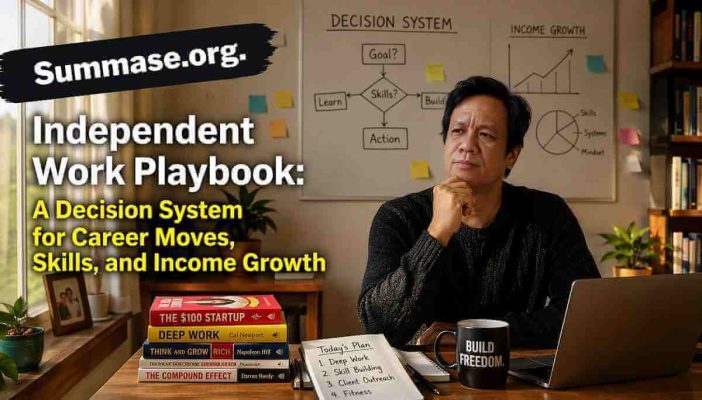
People don’t struggle because they lack motivation. They struggle because they make isolated decisions—what skill to learn, what job to take, what rate to charge—without a unifying system.
The result is predictable:
- Skills that don’t convert into income
- Work that drains energy but builds no leverage
- Income that resets every month
This independent work playbook is built to eliminate that pattern. It connects every career move into a single system: decisions → proof → income → leverage → optionality.
What Is an Independent Work Playbook?
An independent work playbook is a structured decision system that helps professionals choose skills, build proof, generate income, and scale career leverage over time. Instead of random actions, it aligns every move—learning, working, pricing—into a long-term strategy that reduces risk and increases control.
The Core System: How Independent Careers Actually Scale
At its core, career growth is not linear—it’s systemic.
The 5-Layer Career System
- Decisions → What you choose to learn and pursue
- Skills → What you can actually do
- Proof → Evidence others can trust
- Income → Monetization of value
- Leverage → Systems that multiply output
Each layer builds on the previous one. Break the chain anywhere, and growth stalls.
Layer 1: Decision Systems (Stop Guessing Career Moves)
Most people choose careers based on:
- Trends
- Social pressure
- Random opportunities
That approach produces unstable results.
Use a Decision Matrix Instead
A simple framework:
| Criteria | Weight | Score (1–5) |
|---|---|---|
| Market demand | High | |
| Skill fit | Medium | |
| Learning speed | Medium | |
| Monetization path | High | |
| Long-term leverage | High |
Multiply weight × score → compare options objectively.
👉 For a deeper breakdown, see:
[How to Choose a Career Path Using a Decision Matrix]
Layer 2: Skill Acquisition That Converts to Income
Not all skills are equal. The only skills that matter are those that:
- Solve a specific problem
- Have a clear buyer
- Can be demonstrated with proof
High-Conversion Skill Criteria
- Observable output (design, writing, analysis, systems)
- Measurable results (traffic, revenue, efficiency)
- Repeatable process
Execution Model: The 90-Day Sprint
- Weeks 1–3: Learn fundamentals
- Weeks 4–8: Build 2–3 real outputs
- Weeks 9–12: Package and present
👉 See full system:
[The 90-Day Skill Sprint]
Layer 3: Proof Systems (Where Most People Fail)
Skills without proof are invisible.
Proof is what turns ability into opportunity.
Types of Proof That Work
- Case studies
- Before/after results
- Real project outputs
- Testimonials
Proof Hierarchy (Strongest to Weakest)
- Measurable results
- Real client/project work
- Simulated but realistic projects
- Certificates
👉 Why this matters:
[Certifications vs Real Proof]
Layer 4: Income Systems (Beyond Hourly Work)
Income becomes stable when it stops depending on time alone.
3 Core Income Models
- Linear → paid per hour/task
- Value-based → paid per outcome
- System-based → recurring or scalable
Pricing Framework
- Anchor price → set perceived value
- Scope boundaries → prevent overload
- Retainer model → stabilize cash flow
👉 Practical guide:
[How to Price Your Services]
Layer 5: Leverage Systems (Where Careers Compound)
Leverage is what separates busy professionals from scalable ones.
Types of Career Leverage
- Skills leverage → rare + valuable abilities
- Systems leverage → processes that reduce effort
- Network leverage → access to opportunities
- Distribution leverage → audience or visibility
This is where the concept of a career moat becomes critical.
👉 Deep dive:
[Career Moat Framework]
Risk Management: The Missing Layer in Most Careers
Independent work fails not because of lack of skill—but because of unmanaged risk.
Common Risks
- Non-payment
- Scope creep
- Reputation damage
- Income volatility
Basic Protection System
- Clear agreements
- Defined deliverables
- Payment structures (partial upfront)
- Documentation
Before handing over client work, establish clear acceptance criteria for each deliverable so both parties understand what must be verified and approved before the project can be closed.
👉 Full framework:
[Independent Work Risk Management]
Building an Opportunity Engine (Instead of Chasing Jobs)
Opportunities don’t come from applications alone.
They come from visibility + trust + timing.
The Opportunity Engine Model
- Proof → attracts attention
- Distribution → increases reach
- Network → accelerates access
👉 Step-by-step system:
[Building a Personal Opportunity Engine]
The Independent Work Loop (How It All Connects)
Here’s the loop that drives long-term success:
- Choose a direction (decision system)
- Build a skill with output
- Turn output into proof
- Convert proof into income
- Reinforce with systems and leverage
- Repeat at a higher level
This loop compounds over time.
Common Mistakes That Break the System
- Learning skills without a monetization path
- Building proof without targeting real demand
- Pricing too low without a strategy
- Ignoring contracts and risk
- Chasing trends instead of building leverage
Each mistake slows or resets progress.
Practical Workflow (Start Here)
If you need a starting point:
- Choose 1 skill with clear demand
- Build 2–3 proof-based projects
- Package your work into a simple portfolio
- Set a basic pricing structure
- Start small, refine quickly
- Systematize what works
FAQ
What is the fastest way to start independent work?
Choose a skill with clear demand, build 2–3 proof-based projects, and start offering services at a simple price structure. Focus on execution speed over perfection.
Do I need certifications to succeed?
Not always. Certifications help in regulated fields, but in most cases, real proof—projects and results—matters more to clients and employers.
How do I make my income stable?
Shift from one-time work to structured pricing (retainers, packages), and reduce risk with clear agreements and repeatable systems.
Final Step: What You Should Do Next
Start with one decision. Not ten.
- Pick a direction using a decision framework
- Build proof, not just knowledge
- Convert proof into income early
- Protect your work with simple systems
- Repeat until leverage builds
If you want to understand how all supporting systems connect, go back to the main category:
👉 [ Career Strategy & Independent Work]
Reference
Framework-based career thinking aligns with research from institutions like Harvard Business Review, which emphasizes decision quality over effort in long-term professional growth.